

To take any committed action, we need to think things through — and most of the time, being in the process of thinking is itself hard work. Sometimes we lack enough know-how on the subject and get stuck in the thinking process, and that’s what ends up standing between us and our goals.
When I was working hard to think through my consultancy practice, I’d get nervous, and my attention would drift toward everything that might go wrong. It was tough to think without thinking about the negatives and the risks, because my thought process was busily generating counterproductive emotions — which confused me and discouraged me from taking the first step. Has that ever happened to you?
In this blog, I want to share some research-based insight into why we get derailed in the thinking process — and how that understanding is the first step in learning how to set goals you’ve never attempted before.
As Thomas B. Czerner put it, “the brain carves patterns and searches for them endlessly.”
Scientists have discovered that our brain is a connection machine. Its underlying job is to find associations, connections, and links between bits of information. Our thoughts, memories, skills, and attributes are vast connections — “maps” — joined together through complex chemical and physical pathways.
Research also says our brains like to create order from chaos. So the brain keeps processing data, making links between pieces of information so our lives make more sense. We feel more comfortable surrounded by order — inside symmetry, where we can see how everything connects. We like predicting how situations will turn out.
So when we think about goals — especially new ones — we’re asking the brain to create new mental maps. To do that, it has to compare, associate, and match new ideas against our existing experiences, beliefs, and maps. That’s why we feel a degree of inertia around thinking. The thinking process needs a systematic approach, or the support of a coach.
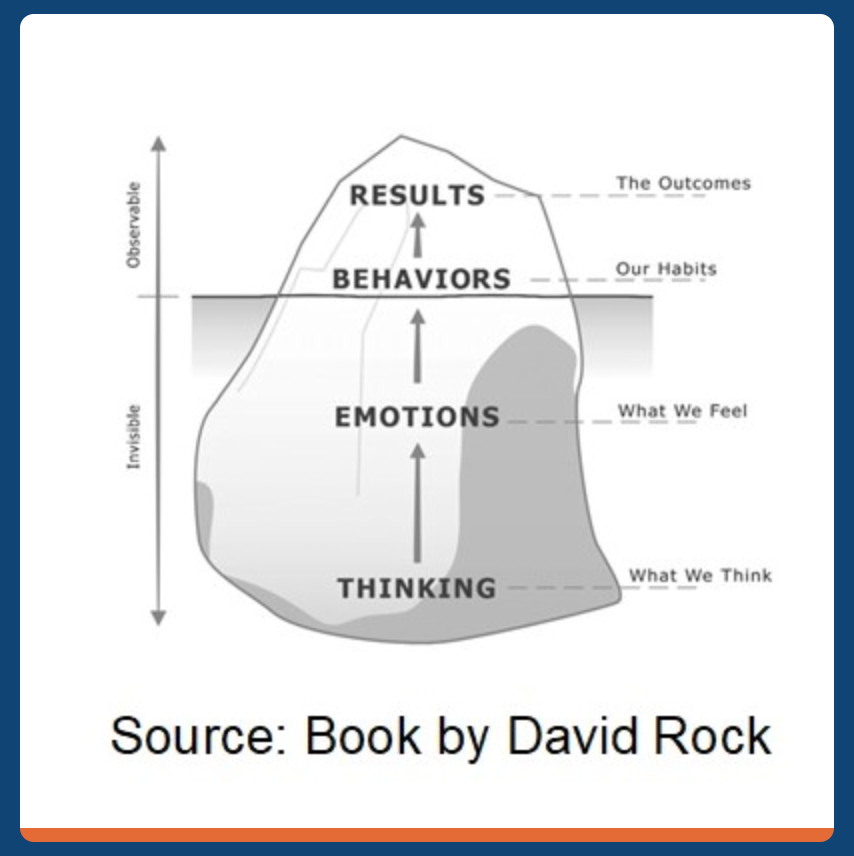
Source: Book by David Rock
This is exactly what the iceberg above illustrates: our results and behaviours are the visible tip, but they rest on the emotions and thinking hidden beneath the surface. If you want to change what shows up at the top, you have to work at the level of thinking underneath.
To solve my own challenge, I approached the goal statement differently. I set a goal of collecting data — to help my brain gather new information. I wanted my inner self to support me and give me the courage to do something I’d never done before. So I began by enrolling in courses, engaging a professional leadership coach, and forming a group of councils. With this approach, I got the chance to learn far more about this career path, and the coaching sessions helped me think through how to overcome the challenges and work with my insecurities, beliefs, and fears. When we help the brain build a new map, it releases energy — and suddenly there’s a strong motivation to act. That’s often the missing piece in how to achieve your goals: not more willpower, but giving your brain the new information it needs.
If you’re about to start working on something new — genuinely new, the kind of goal setting for beginners that feels daunting — I hope this article brings you some clarity. And if you’d like someone to support you in achieving your goals, write to me; goal setting coaching is one of the areas I work in most.